



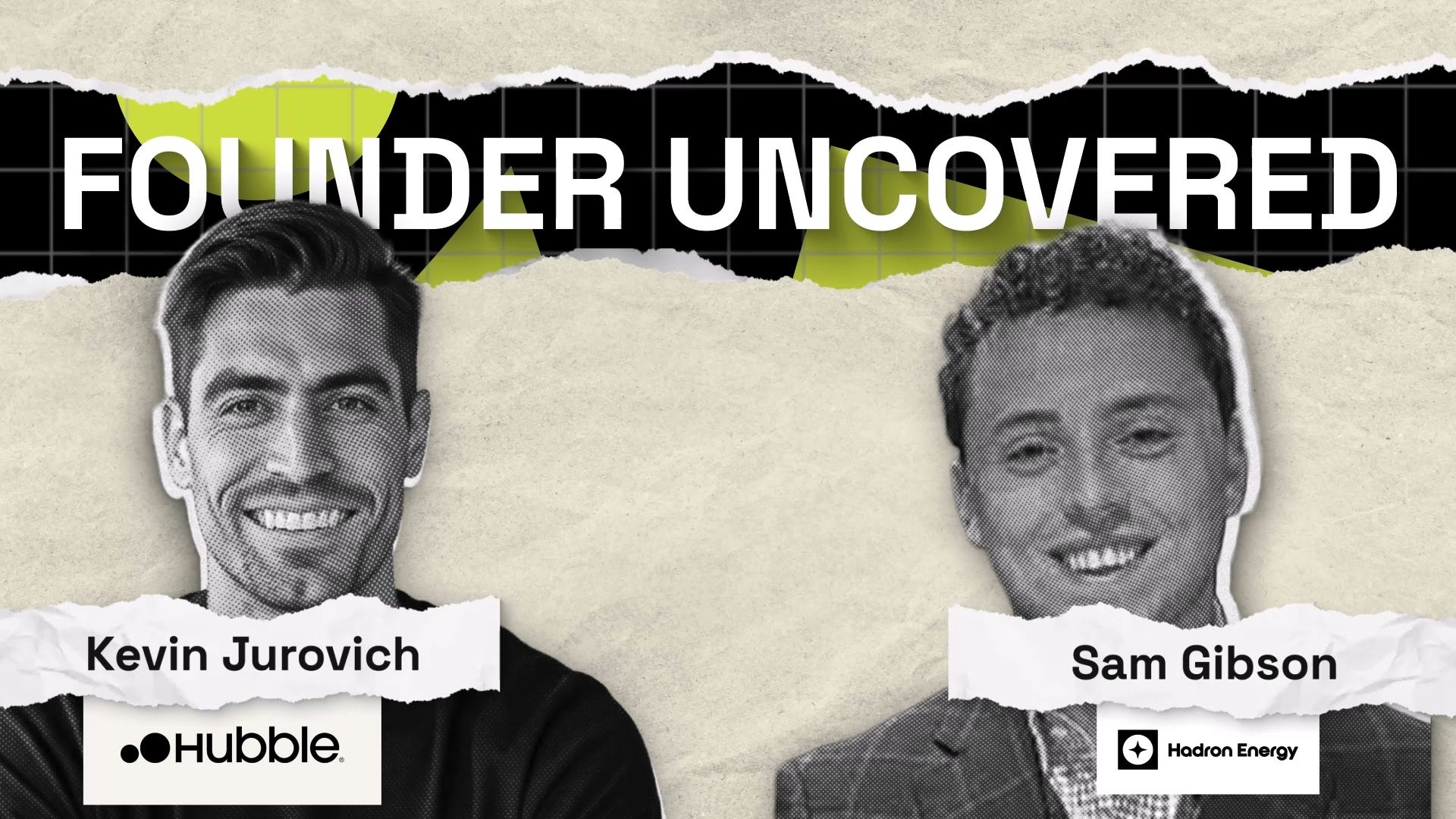
Sam Gibson left a stable engineering job in Kansas City with $10,000 in his bank account and a plan to build a miniaturized nuclear power plant. Two and a half years later, his company is merging with a publicly traded entity at a $1.2 billion valuation. The story between those two facts is the one worth telling.
A Cold DM and a Calculated Leap
The first move Sam Gibson made toward building Hadron Energy was sending a direct message to a founder he had never met. He was living in Kansas City, working a steady engineering job, and describing a business idea that even his eventual mentor, podcast host Kevin Jurovich, privately filed under “crazy or genius.” Kevin, a founder himself who makes a point of responding to early-stage builders, got on a phone call with Sam. Then another. Then several more.
“I thought you were partly crazy,” Kevin admitted during their recent sit-down on the Founder Uncovered podcast. That was in 2023. Sam was 22 years old.
By July 2024, Sam had packed his car and driven to what he thought was the Bay Area’s promised land. He landed in East San Jose, a neighborhood Kevin described diplomatically as “the opposite of quintessential San Francisco,” and signed an Airbnb lease that doubled as his founding office. He officially incorporated Hadron Energy there, with roughly $10,000 to his name and no investors yet on the cap table. The first check he received was $2,000. He took it.
What Hadron Actually Builds
Hadron Energy is developing what Sam calls Lightwater Micromodular Reactors, a compact nuclear power system that produces 10 megawatts of electric output, enough to power 10,000 homes simultaneously. The company is targeting data centers, critical infrastructure, and remote communities as its first customers, positioning clean nuclear energy as the most direct answer to what Sam describes as the defining constraint of the AI era.
“Power is the limiting factor for AI,” Sam said. “When you’re talking to hyperscalers and data centers, that’s the most important thing.”
The company’s engineering headquarters remains in the Bay Area, where Sam draws from a hiring pipeline anchored at Berkeley and other regional universities. Sam himself now lives in New York City, where he leads the capital markets work for the company’s pending NASDAQ listing.
To date, Hadron has raised just over $8 million across pre-seed, seed, and a small Series A. The company is currently merging with GigCapital7, a Special Purpose Acquisition Company (SPAC) with $212 million in trust. Bankers have valued Hadron at $1.2 billion. Sam expects net proceeds of approximately $200 million after what he anticipates will be a low redemption rate, plus an additional private investment in public equity (PIPE) raise he is actively leading.
The Builder Behind the Company
Sam’s background is in mechanical engineering and engineering leadership, which explains both how he got here and how he thinks. He does not describe himself as someone who woke up one morning with a billion-dollar idea. He describes himself as someone who always knew he would start a company and spent years building toward the moment when it made sense to stop preparing and simply move.
“There always comes a day when you have to stop studying and just make the jump,” Sam said. “There’s always the analysis paralysis where you get stuck in a loop of doing constant research. There’s something to be said about trusting your instincts.”
At 24, Sam leads a team that includes engineers and professionals significantly older than he is. He addresses the age dynamic with a straightforwardness that reflects how he approaches most things. “If you surround yourself with the right people, age doesn’t matter,” he said. “There shouldn’t be an age requirement for success. I don’t subscribe to that mentality.”
His personal routine reflects someone who treats operational consistency as a professional edge. He goes to bed early, wakes up early, and keeps regular dinner hours. He called himself “an old soul” with a laugh, but the point underneath the joke is a genuine one: he structures his days to protect his capacity to work.
Two books he returns to are Robert Greene’s “The Laws of Human Nature,” which he recommends for any founder navigating investor and team relationships, and “Meditations” by Marcus Aurelius, which he credits with shaping his long-term mindset. “If you have the right mindset, you can do basically anything,” he said.
How Survival Became Scale
The hardest stretch of the Hadron story is not the merger or the regulatory meetings in Washington. It is the months between Sam’s first $2,000 check and the point when checks started arriving fast enough to keep the company alive.
“I started the company when I had like $10,000 in my bank account,” Sam said. “Many months later, I had $20,000 and I’m like, I’m going to be patient. We’re going to keep pushing. There were many times where I felt if I don’t receive this investor check, this is going to put me in a really hard spot.”
He does not frame those months as a crisis he survived. He frames them as the natural cost of operating at the idea stage in a capital-intensive industry during a difficult fundraising environment. What kept him moving was a belief that persistence in the right direction compounds over time. The first round target was $500,000. It took longer than he expected, but he closed it through friends, family, and former colleagues. Then the checks grew. A $100,000 investment. Then $200,000. Then several at $500,000. Then the first million-dollar check arrived.
“It’s a lot of work and legwork to get from the early day angel checks to the more institutional, sophisticated investors,” Sam said. “Those are the folks we’re talking to now.”
The regulatory side presents its own sustained challenge. Nuclear energy requires ongoing engagement with the Nuclear Regulatory Commission, the Department of Energy, and other federal bodies. Sam travels to Washington frequently, describing the process as one that rewards consistency and direct contact. “It’s about showing up and having boots on the ground, face to face interaction,” he said. “That is really what drives the ball forward.”
He described the diligence process behind the SPAC merger as something he will never forget, and not because of the valuation number. “I cannot believe how much diligence went into that merger and going through the process,” he said. “It was obviously very exciting.”
What the Next Chapter Looks Like
Sam’s goals for 2026 center on completing the NASDAQ listing, scaling the engineering team, and making measurable progress on the licensing work that will eventually allow Hadron’s reactors to connect to the grid. He also wants to build the brand into something recognizable beyond the capital markets audience currently paying attention.
“I really want to make Hadron a name brand so that when people think of clean energy, they think Hadron,” he said. “A nuclear reactor is pretty complex, but what we’re doing is trying to make it as simple as we possibly can for the average person to understand.”
The mission framing is consistent and specific. Sam has repeated throughout this journey that the valuation and the capital story are tools, not the destination. Putting reactors on the grid is the destination. Everything else is infrastructure toward that goal.
When Kevin asked Sam what personal quality he credits most for how far Hadron has come in under three years, Sam did not hesitate. “I am very stubborn and very persistent,” he said. “If you truly believe this is the right way, you stick to your guns. Naturally, people will follow that the longer you do it. I know for a fact where I’m going. It’s a matter of if this person wants to join.”
That is not the language of someone chasing a valuation. That is the language of someone who once sent a cold DM from Kansas City with a nuclear energy idea and a very clear sense of what came next.
This season is supported by Perkins Coie. Perkins Coie is a leading international law firm known for providing high-value, strategic solutions. The Emerging Companies and Venture Capital team counsels startups and the investors who back them, supporting clients from formation to exit. In the past three years, clients have raised more than $23 billion in private markets between the pre-seed and growth stages. Perkins Coie combines tailored counsel with sector experience, so when it’s time to accelerate, whether for the next financing round, a strategic deal, or going public, your team is ready. To learn more, visit perkinscoie.com
More from Uncovered Media


