



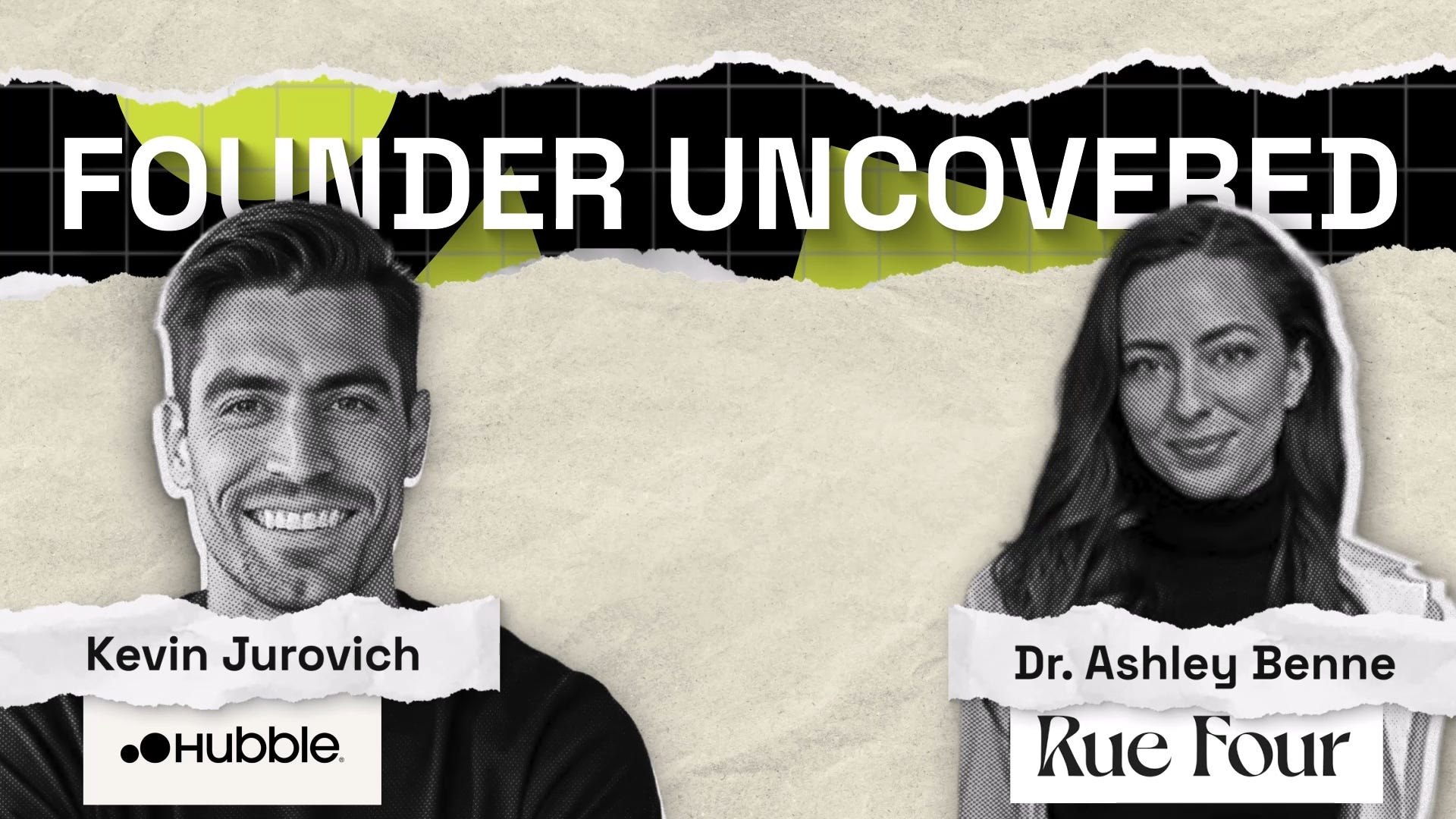
Dr. Ashley Benne built her entire identity around becoming a surgeon, achieved it, and then chose to walk away from it completely. The piece centers on what it actually takes to shed a hard-won identity and start over from scratch, including sleeping on couches, being thrown out of offices, and learning an entirely new language of business while still fluent in the old one.
The Identity You Have to Leave Behind
Most people work their whole lives toward a goal. Fewer actually reach it. And almost none of them walk away from it once they do.
Ashley, co-founder and CEO of Rue Four, spent her entire childhood pointing toward medicine. Her mother’s side of the family is full of pediatric and prenatal surgeons. By the time she was eight years old, she was handing out Tic-Tacs to neighbors and telling them she was curing them. That was not a hobby. That was a preview. She went on to practice reconstructive hand and burn surgery, completing one of the most demanding professional paths available to anyone in any field.
Then she left.
What made her go was not dissatisfaction with medicine. It was a recurring frustration that the tools available to doctors were failing them in basic, fixable ways. Fragmented systems, paper charts, and workflows that had no business existing in a modern clinical setting. Ashley was wasting time on infrastructure, not patients.
“I always felt like what I was doing could be a lot more efficient,” she said. “That was the first thing that showed me.”
She started small: a no-code app, something closer to a well-organized spreadsheet with a cleaner interface. She shared it with colleagues. They used it. And then she started wondering whether the problem was big enough to build a real company around.
Meet Rue Four, and the Sister Who Co-Founded It
Rue Four is building an operations platform for medical practices. The company connects clinical workflows to the financial and administrative systems doctors rely on, creating what Ashley describes as a single front door for communication between teams that rarely share the same information. The target customer is a surgeon or practice owner who is moving fast, has no patience for friction, and would rather focus on patients than toggle between five disconnected tools.
The company she built to solve this problem was co-founded by her sister, Jessica de Mier, who came from a journalism career that included time at CNN. The two of them grew up moving across continents, including stints in Germany, California, Mexico, and Spain, and their closeness as siblings traces directly to that peripatetic childhood. When you keep changing schools and cities, you hold onto whoever stays constant.
Jessica is the growth engine and Ashley executes. “Jessica’s a little bit more of a visionary and a dreamer,” Ashley said, “and that balances out someone like me, who gets really deep in the details.” Their roles do not overlap much, which is part of why the partnership works.
When investors first learned they were siblings, reactions were mixed. Typically, investors were already 20 conversations deep into due diligence. “I mentioned it down the line,” she said. She believes their relationship is one of their biggest superpowers.
Getting Kicked Out on Fifth Avenue
The first serious test of whether any of this was real came when Ashley stopped building for herself and started trying to sell to others.
She was in New York, working out of a “WeWork” on 18th Street, and she needed early customers. So she went to get them the only way available to her: walking up and down Fifth Avenue in the cold, knocking on doors at plastic surgery practices. “Nine out of 10 times I got kicked out,” she said. Surgeons were in surgery. The front desks had no idea who she was. Nobody was interested in whatever a stranger was selling from the street.
She tried paying for lunch-and-learns to get five minutes of a surgeon’s attention. She tried booking patient appointments. She did whatever it took to get face time because cold emails and calls were getting her nowhere.
What eventually worked was credibility. Once a practice realized she had actually been a surgeon, the dynamic shifted. She walked into a plastic surgery office on the Upper East Side, pitched the founding surgeon on the product, and walked out with her first angel check: $50,000. He had first tried to hire her. When she made clear she was going to start the company, he invested instead.
“For any founder,” she said, “the first time you find a paying customer or someone who believes in what you’re doing, that was enough for me.”
Two months later she left medicine entirely.
That transition was not clean. She had no apartment in New York. She was sleeping on friends’ couches while launching a product and learning a profession she had never trained for. The financial language, the operational language, the venture language: all of it was new. She had spent years mastering how to mend a broken bone. Now she was figuring out what an engineering manager actually does.
“Ask me two years ago,” she said, “I would have never thought I would be doing this.”
What Building Actually Looks Like
The early mistakes were predictable in retrospect but painful in the moment. Hiring moved faster than judgment. The initial go-to-market approach created friction that only became visible after repeated failure to grow past it. “I was approaching it from the wrong side,” she said. “I realized I was going to bang my head against the wall a million times.”
The correction required slowing down, interrogating the assumptions baked into the product, and reframing who it was actually for and how it was being sold. Rather than treating the pivot as a failure, she used it to fuel her initial assumptions. The learning-from-mistakes posture she developed in medicine, where the stakes of overconfidence are permanent, carried directly into how she runs the company. “Surgeons, you’re always kind of learning with what’s happening,” she said. “You never grow out of imposter syndrome in the clinic, and it keeps you very humble.”
On hiring, she has landed on a framework that several of her peers recommended: take your time bringing people in, and move fast when something is not working. When evaluating whether someone belongs on the team, she asks a simple question: Knowing everything she now knows about this person, would she hire them again? If the answer is not a confident "yes," she treats it as her answer.
Her broader philosophy for navigating decisions she does not yet know how to make is equally direct. When she needed to build out an engineering team, she cold-messaged Uber's former chief technology officer on LinkedIn. He responded. One conversation led to introductions, and some of those introductions became the engineers now leading Rue Four’s technical team, people who came from Uber and DoorDash. “One of them ended up leading our team,” she said.
That approach, asking people who have already done the thing, has become her primary operating system. She calls friends with companies when deals start going sideways. She reaches out to people she has never met when she hits a question she cannot answer alone.
“You’re only as smart as what you know,” she said. “The ability to just ask people has 10x’d anything I could have done by myself.”
This is a meaningful shift from the culture she trained in. “The motto in the clinic was, at the end, you’re always alone,” she said. In a tech company, that kind of isolation is a liability.
Where Rue Four Goes From Here
In 2026, Ashley’s focus is on building the team that can carry the product to the next stage. Rue Four has onboarded hundreds of clinics and is continuing to grow. The engineering team is expanding. The product roadmap includes Agentic workflows, AI forecasting and streamlining supply chain built specifically for clinical operations, capabilities that did not exist in a form that worked for the people who needed them most.
The vision is to make modern operational infrastructure available to every medical practice, a category that has historically received less attention from technology builders than its size and complexity warranted. Ashley sees AI as the accelerant that makes this moment different from what came before.
But the North Star she returns to is simpler than any roadmap. “When I have a doctor get on the platform for the first time and say, you’ve changed my day-to-day,” she said, “that’s what makes me so bullish on the decisions we're making.”
She built her first career around the idea that one person with the right training could help one patient at a time. She left that career when she realized the math could be better. The identity she shed to get here was not a sacrifice. It was a trade: one kind of impact for another, larger kind, scaled through software instead of surgery.
This season is supported by Perkins Coie. Perkins Coie is a leading international law firm known for providing high-value, strategic solutions. The Emerging Companies and Venture Capital team counsels startups and the investors backing them, supporting clients from formation through exit. In the past three years, clients have raised more than $23 billion in private markets between the pre-seed and growth stages. Perkins Coie combines tailored counsel with sector experience, so when it’s time to accelerate, whether for the next financing round, a strategic deal, or going public, your team is ready. To learn more, visit perkinscoie.com
More from Uncovered Media


