



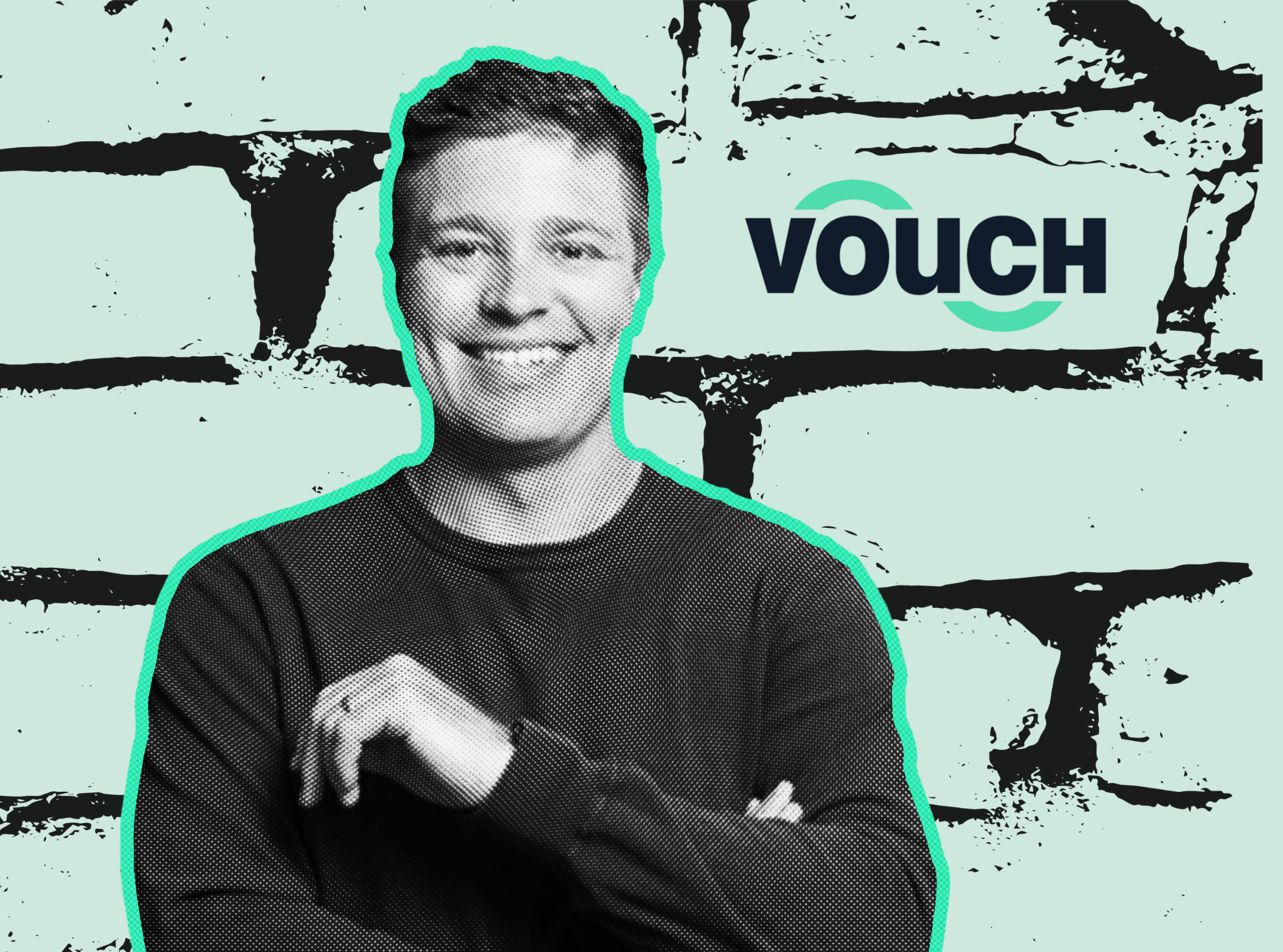
A few years ago, Travis Hedge would tell anyone who would listen that building a full-stack insurance carrier was the only way to fix startup insurance. He and his co-founder Sam Hodges had raised $25 million to do exactly that. They launched the first comprehensive crypto coverage in the U.S., built custom policies for AI companies before most people knew what a large language model was, and grew Vouch to serve thousands of startup clients from seed to IPO.
Then he sold the carrier. The market had caught up, and staying a carrier was no longer the right thing for the client. “If you go back in time and you listen to me on podcasts a few years ago, I was like, pound on the table, the carrier’s the right move,” Travis said. “And I was wrong about that.”
Meet Travis Hedge
Travis grew up in Columbus, Ohio, around a family insurance agency where the dinner table doubled as the boardroom. Both of his brothers are entrepreneurs. He points to that early exposure, alongside the hardship that came with it, as the foundation for everything that followed.
After college at Ohio State, he joined Nationwide’s rotational program and spent weeks pitching 30 senior leaders on why the company should launch a ventures arm. Twenty-nine of them told him it was a cute idea. The 30th, a private equity leader named David Verbance, said, “Hey, I’ve been looking for someone like you to go do this with. Let’s go.”
Together they pitched Nationwide’s CIO, won an allocation, and started writing LP checks on Sand Hill Road. One went to SVB Capital’s third direct fund. Walking out of that meeting, David turned to Travis and told him to apply for an open role on the SVB team. “I just felt so lucky to have someone like him in my camp,” Travis said.
“It’s better to be lucky than good.”
At SVB Capital, Travis was hired to build spreadsheets and analyze deals. Not to source them. He asked if he could try anyway, and the answer was, “Have at it.” He reconnected with Alex Timm, a Nationwide colleague who was raising capital for Root Insurance, and built a reputation as the insurtech person in the room. That led to a working relationship with Nick Shalek at Ribbit Capital, who would eventually reconnect Travis with Sam, his future co-founder.
Meet Vouch
Vouch provides commercial insurance to startups and high-growth companies. Travis and Sam started the company in August 2018 with a one-year deadline to launch their first products. They shipped on August 19, 2019. Travis was in Utah, their first launch state, selling policies door to door, while Sam was on stage at Y Combinator’s demo day.
“I gotta give the TaxBit founders a lot of credit for believing in us and being our first client,” Travis said. The website still said “stealth mode” behind a password.
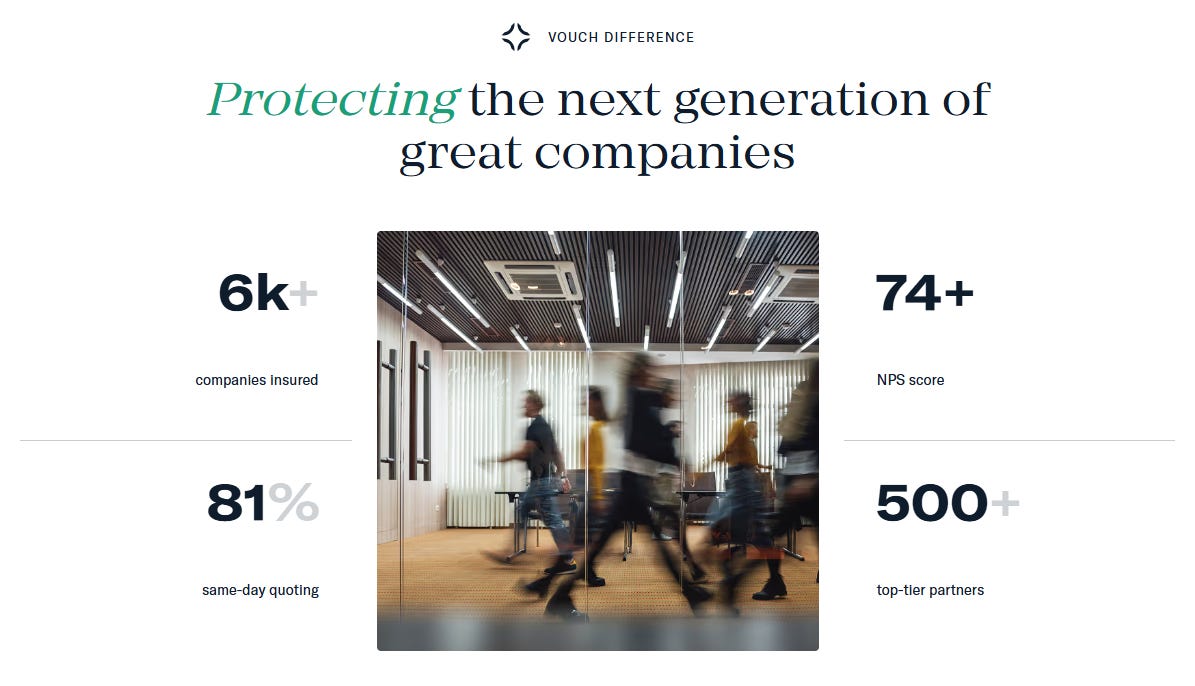
Today Vouch serves over 6,000 clients and holds between 15 and 45 percent market share among startups backed by tier-one venture firms like Y Combinator, Andreessen Horowitz, and Sequoia. Net revenue retention runs well north of 100 percent. “It looks a lot more like a SaaS business as a result,” Travis said.
Why Build a Carrier, Then Walk Away
When Travis and Sam started Vouch, three conditions made the carrier path necessary. API-based quoting was nascent, so instant coverage was not possible through existing providers. Carrier appetite for emerging risks like crypto and digital health was nonexistent. “Typically a big insurance company is not gonna get out of bed unless the number starts with a B,” Travis said. And cheap capital from the zero interest rate policy (ZIRP) era made it feasible to fund the balance sheet a carrier requires.
Vouch built its own underwriting capability, started taking risk on its own balance sheet in 2021, and developed first-of-their-kind policies in crypto and AI. But the company also stood up a brokerage business alongside the carrier, and that business started growing fast. It was capital light, more nimble, and better for the client.
By 2022 and 2023, the original conditions had shifted. Capital got expensive. Carriers developed sophisticated APIs. Appetite for startup risks grew. Meanwhile, Vouch had tens of millions of dollars sitting on its balance sheet reserved for claims, and ChatGPT had just arrived.
“We started increasingly seeing what was possible with AI, and we recognized we’re spreading our resources super thin. We had a unique opportunity to sell the carrier, unlock a ton of capital, reach profitability as a business, and then put all of our resources into building the brokerage of the future.”
Hiscox bought the carrier in the summer of 2025. The final close wrapped up a few weeks before this conversation.
The Insight That Held
One of the most counterintuitive lessons Travis carried from Nationwide showed up again at Vouch. At Nationwide, there was an annual study showing that roughly 50 percent of customers, no matter what, always want a human agent. Travis assumed startup founders would be different.
“To this day, no matter how self-serve you make the product, about 50 percent of people, no matter how small or big they are, want to hop on with a human advisor and have a conversation.”
That finding shapes how Vouch deploys AI. The goal is to make the advisor’s job easier so they can spend more time building relationships and developing expertise. Travis sees a parallel to how technology transformed registered investment advisors rather than replacing them. Vouch plans to scale with flat headcount as it rolls out more technology across the business.
Both Sides of the Table
Travis’s years as an investor gave him an unusual perspective on fundraising. He spent years building relationships with the people who eventually funded Vouch, long before the company existed.
“Investors invest in lines, not dots. I’d been talking to the people around the table who funded the business for years about these ideas, and they had seen me grow for years.”
The first couple of rounds did not require a formal process.
Vouch raised a $25 million Series A in 2018, incubated between Ribbit Capital and SVB. Y Combinator’s Continuity Fund led a $75 million Series B in late 2019. Redpoint and Allegis Capital came in for a $60 million Series C in late 2021. Inside investors contributed roughly $45 million more in a Series D in 2024. With the carrier sale in 2025, the company is fully capitalized and at the verge of profitability.
Travis frames the fundraising dynamic simply:
“It’s a little bit like dating. You gotta go get to know a lot of people and kiss a lot of frogs and run a great process. But you also always want to put yourself in a position to be the one being asked to dance rather than having to go ask others to dance.”
After the Series B, the dynamic shifts. “Once you’ve raised a Series B, it’s a metrics game. You’re now raising on your metrics and gotta sing for your supper.”
The Vouch 2.0 Playbook
A few months ago, Sam approached Travis about taking over as CEO. Sam had been CEO since the founding, with Travis serving as CRO. “He approached me and said, ‘Hey, it’s been a long run, we’ve been through a lot. I’m pretty tuckered out, but also I think you’re the right person for Vouch 2.0,’” Travis said.
At Camp Vouch, the company’s annual all-hands in Austin, Sam took off his cowboy hat, put it on Travis’s head, and handed him a belt buckle that read “El Jefe.”

Travis moved the company’s fourth hub to Columbus, where he and his wife are raising their two children close to their families. He now splits his time across offices in San Francisco, New York, Chicago, and Columbus, hosting founder dinners in each city. The conversations are different depending on the zip code.
“When I’m in San Francisco, founders are talking about the future and AI and how it’s gonna impact humanity. And then when I’m in New York or Columbus or Chicago, it’s a much more applied conversation. I’m sitting here with these founders who are building really profitable, capital-efficient businesses that are applying AI in really leading ways. Having a foot in both worlds has been really healthy for me personally.”
Sequoia recently issued a report calling insurance brokerage the number one opportunity from an AI-native services perspective. Travis is already well down that path. When asked for a closing thought, he kept it simple: “It’s time to build.”
More from Uncovered Media


