



It all started with conversations. A lot of them. The salespeople Steve Ancheta called didn’t know each other and they worked at different companies, in different cities, at different stages of growth, from Fortune 10 corporations to early startups. He asked each of them to walk him through their ideal week in sales: what they should be doing, what they actually do, and how those two things differ.
Every single answer was different, until it wasn’t.
No matter when it fell in the week, Monday morning or Thursday afternoon, each salesperson described a block of time they had to set aside for tasks that had nothing to do with selling. CRM updates. Follow-up notes. Lead research. The details varied, but the pattern held across seven conversations with people who had never met.
“They all had that commonality,” Steve says. “At some point, I have to stop generating revenue to focus on things that don’t generate revenue.”
That informal research exercise, conducted with his two co-founders to help them understand what sales really feels like from the inside, became the organizing principle behind zig.ai. The company’s premise is straightforward: identify every step in the sales process where a human is doing something a machine could handle, then build the infrastructure to handle it.
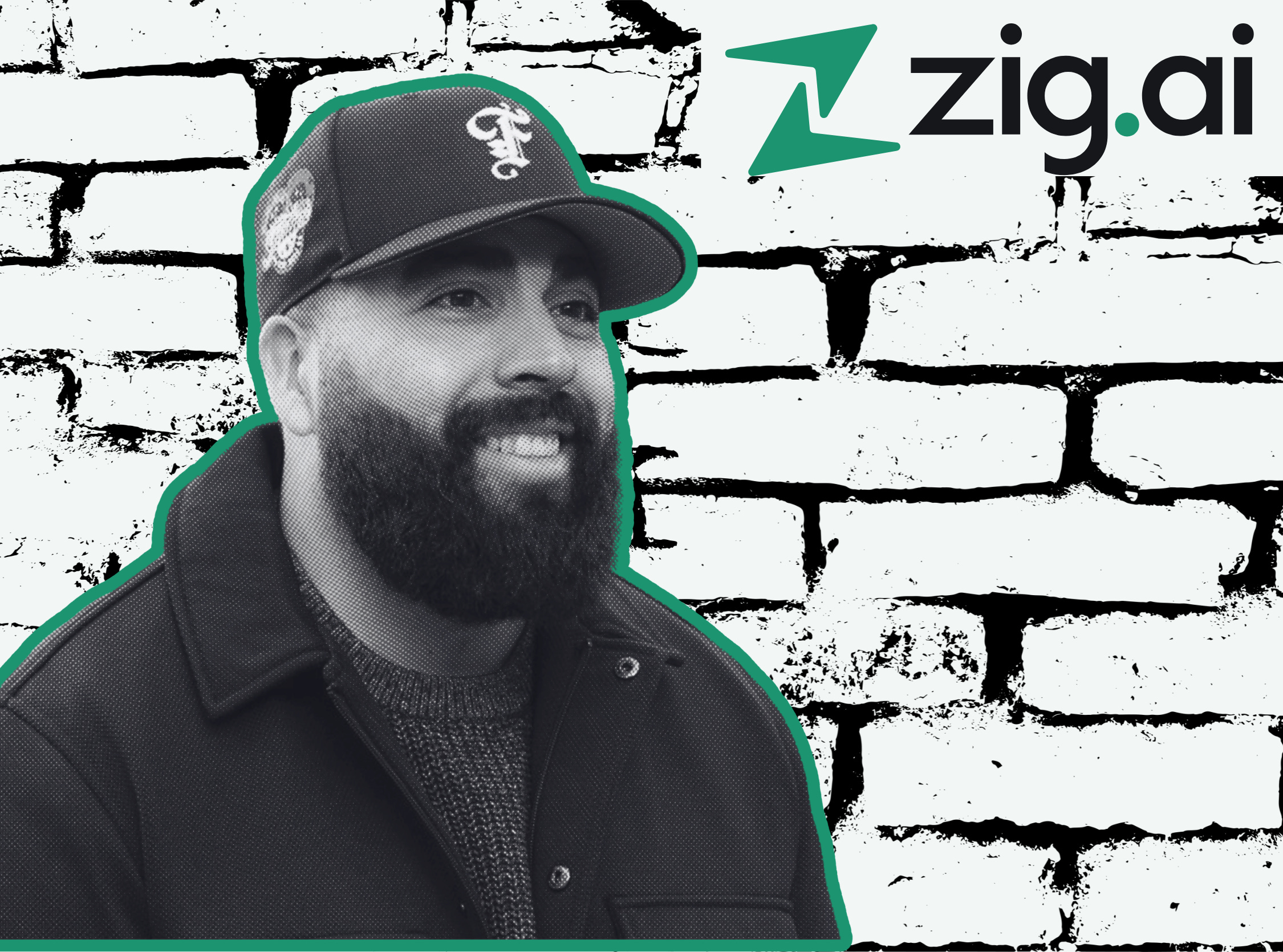
Meet Steve, Founder of zig.ai
He grew up in Boyle Heights, a working-class neighborhood in East Los Angeles where he lived with his great-grandmother in the Estrada Courts housing projects. Raised by parents he describes as young and blue collar. What they gave him wasn’t a pep talk. It was something more durable.
“It wasn’t in an encouraging way like in the movies,” he says. “It was more like, go try it, figure it out. If you screw it up, it’s on you. Take accountability and move on.”
He left college after one semester, decided he wanted a career in sales, and called everyone he knew to find a way in. An organization took a chance on him, and he spent the next 16 years climbing through roles as a sales rep, sales engineer, and eventually the head of sales organizations. That accumulated experience, not a whiteboard hypothesis, is what zig is built on.
zig is an intelligence and execution platform for sales teams. Organizations plug in their existing data, including email threads, ongoing conversations, and CRM records, and zig assembles what Steve calls a “compounding context layer.” Think of it as a shared memory bank that every workflow, every AI agent, and every automated process inside the platform draws from. It learns what has worked historically, adjusts based on new behavior, and uses that evolving picture to make better decisions over time.
The goal is to give salespeople back the hours they currently spend doing things that feel like work but don’t move deals forward.
The Problem Generalists Kept Missing
Steve raised zig’s initial funding from Superset, a venture firm made up entirely of former founders. Getting there required convincing investors who hadn’t spent careers in sales that the problem was real and worth solving.
That turned out to be harder than he expected.
“Explaining sales to non-sales folks is very difficult,” he says. When talking to investors who came from product and engineering backgrounds, he found that some saw sales as a profession where likability and product strength were the primary variables. The operational weight, the quota clocks, the cognitive load of managing a funnel across multiple disconnected tools, didn’t register as structural problems worth solving. They registered as noise.
His advice to founders who hit the same wall is direct. “If you spend your time wondering why a VC said no and why they don’t see your vision,” he says, “you’re going to drive yourself crazy.” The better use of energy is to find the investor who already understands the vertical deeply enough to recognize what the founder is describing. For Steve, that was Superset.
One thing that made the Superset relationship work: all the general partners have built companies themselves. That background, Steve says, produces a different kind of engagement. When he is working through a decision, he walks across the shared office, pulls a GP into a quick conversation, and uses the exchange to organize his thinking. They don’t decide for him. They ask the questions that help him decide faster.
“It speeds up the decision making process,” he says, “much faster than them not being there.”
For early founders trying to evaluate investors, Steve offers a practical filter: find out whether the people writing the check have built something from zero to one before. The intangible value of that experience, he says, becomes clear in the first 30 to 60 days of building.
The Longer View on Sales and AI
Steve has a clear perspective on where AI agents fit inside a sales organization, and where they don’t. The rapid rise of AI sales development representatives, or AI SDRs, producing high-volume cold outreach has already started to desensitize buyers to cold email. When every company targeting the same prospect is sending automated sequences, the volume stops being an advantage. Messaging quality becomes the only differentiator, and most AI SDR tools, Steve argues, operate with too little context to improve their messaging over time.
zig’s outbound functionality takes a different approach. Rather than maximizing volume, it layers context onto outreach, adjusting tone, content, and timing based on industry, team size, and the profile of deals that have closed before. The bet is that precise, well-informed outreach will outperform broad, generic outreach as buyers get better at ignoring the latter.
As for the longer-term question of whether AI replaces salespeople entirely, Steve draws a comparison to what has happened in software engineering. AI has given strong engineers the ability to produce significantly more output without additional effort. He expects the same pattern to play out in sales: the best performers get a meaningful productivity lift, while the gap between top and bottom performers becomes harder to ignore. AI doesn’t directly eliminate roles, in his view, but it reduces an organization’s tolerance for underperformance.
What Steve Would Tell a Founder Starting Today
zig’s thesis was not built on research reports or market surveys. It was built on 16 years inside the profession, a series of direct phone calls, and a willingness to be told no by investors until the right one said yes.
For founders navigating the same early stages, Steve closes with a framing he uses internally: if you are a non-technical founder, be able to explain the micro as clearly as the macro. If you are a technical founder, make the inverse your discipline. Build the skill in whichever direction is harder for you.
“It allows everyone around you to move fast, but with intention,” he says,“Meaning you don’t sacrifice direction for speed. Forward is all that matters.”
More from Uncovered Media


