



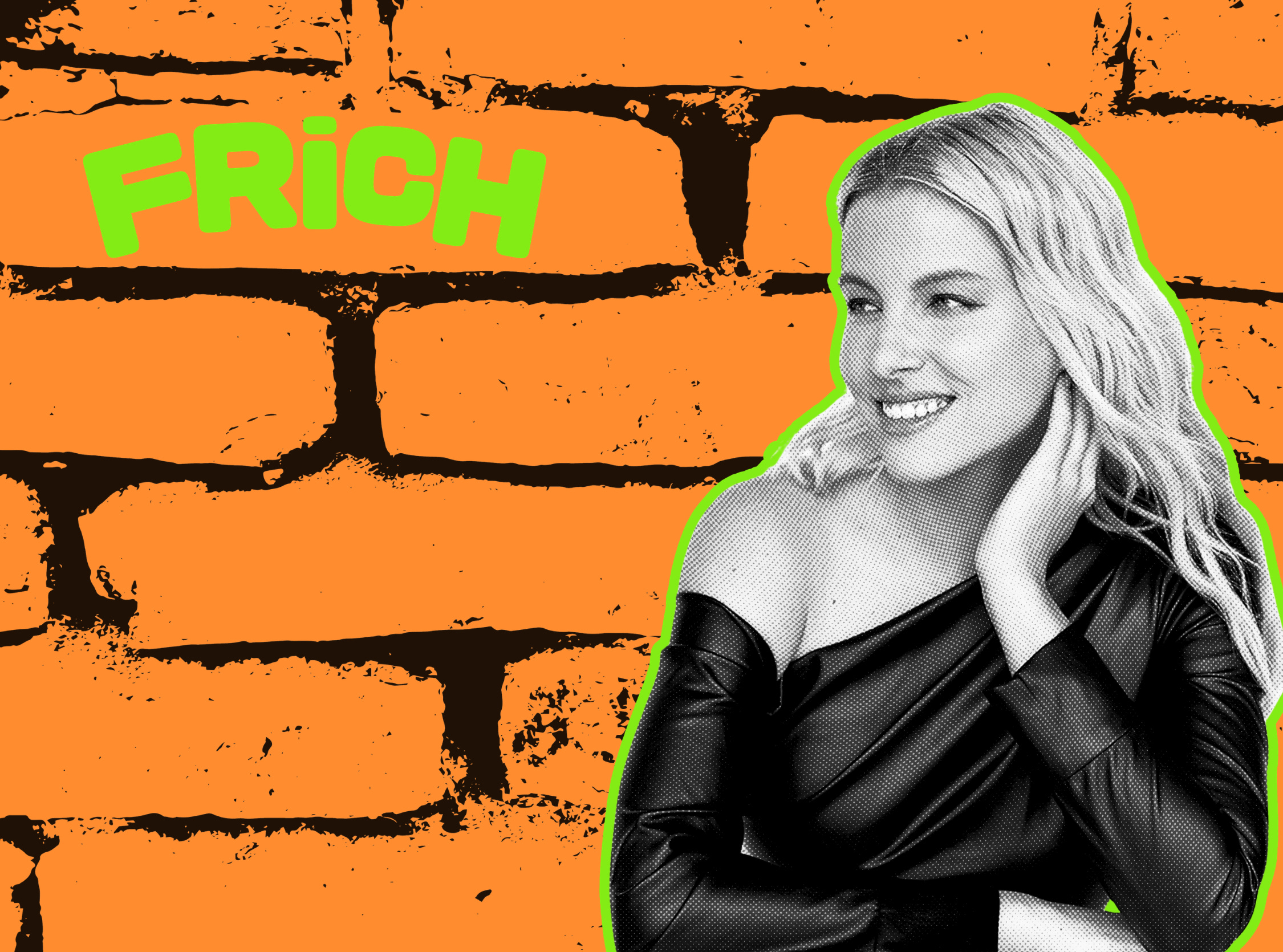
Katrin Kaurov and her co-founder Aleksandra Medina were taking a long walk through New York, trying to decide what kind of company to build. Their first idea was to solve climate change.
“We were like, you know what? We’re just not smart enough for that.” So they kept walking. Then something else clicked.
Money had always been the thing no one helped them with. While neither of them knew the word “fintech” yet, they went back to the small apartment they shared in Chinatown and made a pros and cons list. The cons column filled up fast: no skills, no connections, no money, no green card. The pros column had two entries. They were young. And they were (their words) “kind of tall”.
The two women looked at the lopsided list and said they were going to do it anyway. Then they named their company F*cking Rich.
“There was just a lot of delusion back then in us getting started and being committed to this.”
Katrin still has a screenshot of that pro/con list on her phone. It’s the clearest possible picture of how Frich began, and in a way, it explains everything about how it has grown. Katrin has never makes major decisions for Frich by polling a roomful of experts. She makes them by watching what her users actually do, and then refusing to be talked out of what she sees.
The Problem She Lived First
Katrin Kaurov is the co-founder and CEO of Frich, a social finance platform with 1.6 million users built around the idea that people make better money decisions when they can see what people like them are actually doing.
She is originally from a small town in Estonia, population around 100,000. At 14, she left home to start working, traveling to more than 20 countries over the next nine years. She earned and invested her own money from the beginning with no one guiding her.
Katrin’s experience being financially independent as a teenager with no safety net is the direct origin of what Frich solves. She did not build her company just because she saw a market opportunity. She built it because she had lived the problem.
She mentions the similarities between her early work as a model booking clients abroad and pitching to investors years later. “In both cases, you’re kind of selling yourself.” She found the VC world surprisingly gentle by comparison. “I was shocked that everyone was so nice.”
Pitching her company, though, required a different kind of work. Coming from Europe, where confidently talking about yourself is considered bragging, she had to learn a different register entirely. Ryan Falvey, a partner at Restive Ventures and her lead investor, helped her put her story together in a way that was coherent and memorable. Once the narrative was sharp, everything else followed. Investors responded. Media picked up the story. Users found her.
Making Money Social
Frich exists because traditional financial institutions missed two things about Gen Z. First, money decisions are social. People do not change their financial behavior because of a tool or a calculator. They change it because someone they respect made a similar move first. Second, money sits behind every major life decision, not just savings accounts. Breakups, career changes, moving cities, getting a pet. Frich starts with the life decision, not the financial product.
The platform’s first version tested this the hard way. The original product challenged users to hold their friends accountable for better money habits. “Fair to say people hate their friends around their money,” Katrin said. The real insight: people want context from strangers in similar situations, not accountability from people they know.
“If you’re 25 living in New York making 120k a year, you want to know what people exactly like you are doing with money.”

That pivot shaped everything. Users are now three to four times more likely to convert to a financial product when a peer, specifically someone slightly ahead of them in a similar career, suggests it. Close enough to feel reachable. That is the mechanism.
“Community is not just a fluffy word around finance. Community and peers around you are what drives you to make certain financial decisions.”
The platform’s AI-powered feature, Frich Scoop, lets users take a screenshot of anyone’s LinkedIn or Instagram and receive an estimated income and lifestyle breakdown, covering spending patterns, brands worn, restaurants frequented, and career trajectory. When it launched, over 90% of users scooped themselves first. Nobody anticipated that. People were more curious about how they were being perceived than how anyone else was living.
Frich’s core user skews female, something Katrin attributes directly to her own team’s makeup and the creators they chose to work with early on. “We accidentally built for that community,” she said. That user is typically 23 or 24, one or two years out of school, often already feeling behind.
“They’re seeing TikTokers already retired by the age of 19. By default, even though you went to the best school and have a six-figure job, you already feel like you’re behind.”
One of the sharpest early product lessons came from the onboarding flow. When users were asked to pick a financial goal, most of them froze. They did not know what their goals were. “It’s not a math problem. Anyone can go and figure it out, but people don’t do it because they’re afraid of money.” The app now builds the framework before it asks for the commitment.
To illustrate where she wants to take this, Katrin points to a recent unconventional partnership. Frich collaborated with a prominent New York prima ballerina to reach a community that had essentially no relationship with financial services. A dancer’s career is short. “You’ve got to make very smart financial decisions to protect your future.” The campaign activated millions of dancers and connected them with fertility insurance, directly relevant to their situation. It became one of Frich’s most successful campaigns.
“Fintech is not just for people who work in finance. Fintech is for everyone, and these people are so underserved.”
Building the Expert From Scratch
When Katrin started Frich, she had no fintech credentials, no industry connections, and no roadmap. She and Aleksandra googled how to build an app with no money or skills. There was no ChatGPT yet.
But Katrin had two things: proximity to the problem, and the discipline to document everything she was learning from her users.
“I realized that there’s not going to be a moment when someone is going to label me as an expert if I don’t do it myself first.”
She began posting data and user insights on LinkedIn, launched a newsletter, and positioned herself as a Gen Z money expert. She kept showing up in that lane consistently until the label was accepted as fact.
“If you just build in silence, no one is going to know that you have actually accumulated all this industry knowledge. Building in public, especially in today’s era, is really important.”
The same thinking shaped how she approached her personal story. “You’ve got to spend a lot of time to get to that perfect personal story. But once you’re there, you can’t really deviate. You’ve got to stick to the same story over and over again.” The goal is not self-promotion but clarity, a sharp, repeatable angle that travels.
“Investors are kind of looking for misfits and weirdos. It’s actually easier to stand out if you’re the weird one. At least it’s going to get you the first meeting.”
Getting in the room with investors was one problem. Holding her ground once inside was another. An early advisor told her Frich needed a real CEO, someone with credentials and experience. She was offended. VCs later pushed her to pivot into NFTs and Metaverse events. “I remember thinking, are these people stupid?” She had not yet learned that pushing back was an option. She was doing this every single day, and she understood the Gen Z relationship with money better than any generalist investor operating from the outside.
“The moment I learned to push back, that’s also when raising became much easier for me.”
109 Conversations
Katrin had heard the statistic before she lived it: Go through a hundred VC conversations to get one check. When she hit number 102, she tried to stay optimistic. “I was like, we’re across the mark, so it means we must be close.” The round closed at conversation 109.
One of those discussions started with the investor hanging up the call because he said her idea was stupid. She could not let it go. So she reached back out and got another call. He passed again. She applied to an accelerator his fund opened. No response. She emailed asking if they had received her application. No response. She emailed again. Her final message was black and white: “Are we doing this or what?” The partner replied and wired the money.
“I still today think the first check was a mercy check just to shut me up.”
But for every investor worth chasing past every no, there were conversations she knew were dead and stayed in anyway. “Any time the vibes are off, I wish I would have just dropped those calls. If you know that the conversation is not going anywhere, there’s no reason to send even your materials.” She notes that a clean, respectful exit tends to make investors more curious about you than a slow drag that neither side believes in.
The investors who came through were the ones who understood the vision without needing to reshape it. Frich’s lead investor, Restive Ventures, has invested in the company three times.
“They really understood what we were trying to build. They valued that weirdness and my story and were not trying to push us toward a different direction.”
On evaluating investors, Katrin knows the product will change twenty times, the team will change, the deck will be unrecognizable in two years. The only thing that should stay constant is the core premise.
“If they push back on the vision, I don’t think it’s even your job to try to push it.”
Despite being a female-founded, immigrant-led company, minority-focused funds produced the least traction for Frich’s funding. “We actually got no traction at all with VCs like that. I still until today I’m not sure why.”
The larger lesson she took from all 109 investor conversations is about whose input actually matters. “Anyone’s early investor, early advisor, early anyone’s opinion is irrelevant if you have conviction in your idea.” She wishes she had spent less time building hypothetical four-year revenue models for investors who would never write a check, and more time in front of her actual users.
“The audience chooses. Your user or customer is what’s going to make or break your business, not what some advisor in a cushy job told you on a Zoom call.”
The Extended Marriage
Aleksandra and Katrin were best friends before they were co-founders. They shared an apartment. Katrin describes the shift plainly.
“It’s kind of like going from dating to marriage. You suddenly have this child who’s almost dying every day.”
They handled the structural side before it could become a source of conflict. Equity agreements with vesting periods were in place before Frich had any meaningful traction. “It’s kind of like a prenup. If everything goes right, which has gone right so far, we never have to use them.” Katrin is outward-facing, managing growth, investors, and partnerships. She describes herself as “the person who chats.” Aleksandra builds and executes. “She will hear me on a call talking about something that’s almost ready, and then she’s like, oh my God, we’re going to have to build this faster.”
Katrin says they historically underinvested in celebrating wins, and have worked to correct that. The startup grind produces problems every single day. The relationship needs to be fed, not just tested.
“You need to take in the win and fill your work relationship with that happiness before you go back to the war zone.”
The same philosophy extends to how she runs the company. She does not believe in the all-nighter as a marker of commitment. Her mornings run on airplane mode. She boxes, runs, practices Muay Thai, and does a weekly sauna and cold plunge session.
“You’ve got to treat your body like an athlete. You’ve got to be at peak performance. There’s no glory in treating your body like trash and then probably not being that productive.”
The culture at Frich is locked-in focus during work hours, followed by genuine rest. “This is not a sprint. It’s a marathon.”
On hiring, Katrin’s thinking has shifted with the company. Early Frich needed generalists, people with tenacity and adaptability. Scaling Frich requires specialists. “At some point as you scale, everything I believed in was no longer true. You get so much value from someone who’s been around the block for a decade or longer.”
Follow the User, Not the Room
Katrin is building Frich toward a platform version where every distinct community has its own space, its own benchmarks, and its own financial entry point. The ballerina campaign pointed to something bigger: there are entire communities of people making consequential financial decisions with no tools, no context, and no peers to learn from. First-generation workers. Creators. Blue-collar workers. Artists. Each one underserved in a different way, and each reachable if you start with their life rather than a product. The users who found Frich at 22 are now 27 and 28, and the financial decisions they make only get more complex from here.
“I really think following the user and customer is the most important thing when you’re building a business.”
Katrin builds for people who are afraid to take the wrong financial step, so they take no step at all. People who froze when asked to pick a goal because they don’t have a benchmark for what normal looks like. People who need to see someone like them make the move first. That is who Frich exists for. Katrin’s clarity around this focus didn’t originate from an investor meeting or an advisor call, but from watching her users and building for them.
The room will always have an opinion. The customer will always have the answer.
More from Uncovered Media


