




When Dori Yona needed to figure out how to shut down his startup, he did what most people do when they’re lost: he Googled it.
It was late. He had just come home from a board meeting where investors told him his company, a consumer fintech called Earny, was running out of runway and needed a shutdown plan. He sat down and searched “how do you shut down a startup,” expecting to find a clear process or a service built for exactly this moment. What came back was a blog post from a boutique law firm that looked like it had not been updated in two decades.
That gap between what founders need at one of the lowest moments of their professional lives and what actually exists for them is the entire reason SimpleClosure exists. And Dori’s willingness to plant a business in that gap, in a space most of the startup world treats as taboo, is what makes his story worth understanding.
The Founder Behind the Company
Dori is a serial founder now in his mid-career, running his third company from Santa Monica with four kids and a wife at home. He grew up in Israel, served as a captain in the Israeli Navy, and started his first company in 2014, a mobile dating app that launched before Tinder had fully defined the category. His research process for that product included signing up for every competitor platform available, including Ashley Madison, a detail that became unexpectedly relevant years later when the site suffered a massive data breach. He had to warn his wife in advance. She knew. He had shown her everything.
When asked how he stays a high-performing CEO, his answer bypasses the expected talk of morning routines and workout schedules. “I actually think that having a very supportive wife and kids and family helps me be a higher performing CEO,” he says. “I could not imagine a world where I came home and didn’t have a supportive family and support system.” For Dori, the foundation of his performance at work is built at home.
That same instinct to go all the way in, to use and understand what he was building before claiming he understood it, runs through everything he has done since. SimpleClosure is not a pivot or a trend play. It came directly from personal experience and from listening to dozens of other founders describe the same experience after the fact.
What SimpleClosure Actually Does
SimpleClosure is a platform that helps companies wind down their operations in an organized, legally sound way. The problem it solves is not just paperwork. It is the entire hidden infrastructure that founders need when they decide, or are forced, to close: understanding severance obligations, resolving office leases, managing vendor liabilities, filing the right state and federal dissolutions, and avoiding the kind of financial exposure that can follow a founder long after the company is gone.
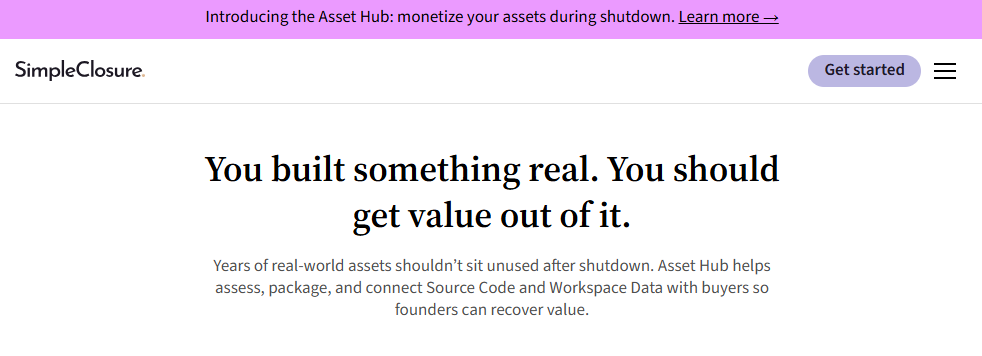
More recently, Dori’s team launched a product called Asset Hub, which helps shutting-down companies monetize the value they have left: code bases, workspace data, domains, patents, trademarks, and in some cases the talent on their teams. The idea is that a company coming to SimpleClosure to close should ideally leave with more money than it arrived with. According to Dori, that has already happened for customers who came to the platform with barely enough to cover shutdown costs and walked away with six figures.
A Market Hiding in Plain Sight
Most people assume the shutdown market is small because they never see it. No one posts about it on LinkedIn. Founders quietly remove failed companies from their profiles or describe their tenures in ways that obscure what happened. The silence creates the impression that this is a rare event, when the data says otherwise.
In the United States, roughly 4 million companies close every year. About 1 million of those have employees. The number that incorporates in a given year is nearly identical, which means the overall count of active businesses in the country has stayed roughly flat at around 30 million for decades. Dori started SimpleClosure focused entirely on venture-backed and technology startups, but the platform has since expanded to serve the broader small and midsize business market. Based on how states categorize industry data, Dori estimates technology companies represent somewhere between 10 and 15 percent of annual closures.
The market is not small. It is just invisible.
Three Parallel Workstreams Nobody Can Know About
When a startup begins its decline, the founder rarely gets to deal with just one problem at a time. Dori describes what he hears from customers as three simultaneous workstreams, each one requiring a different story to be told to a different audience.
First, the founder is still trying to run the business. Second, they may be in active conversations with existing or new investors, selling optimism and forward momentum. Third, they may be quietly exploring whether the company can be sold for whatever it can get. Each of these tracks has to stay separate because the moment any one group learns about the others, the whole situation collapses.
“Your employees, your partners, your customers, your investors,” Dori says. “Like it’s all, you’re kind of doing something behind the scenes.”
The only people typically inside the full picture are co-founders, if any are still around, and a senior finance person. Everyone else operates on incomplete information while the founder holds the rest together. It is a structural loneliness built into the final phase of a startup.
Why Grit Becomes a Trap
Dori does not use the word “failure” much. He has clearly thought carefully about how language shapes a founder’s ability to make clear-eyed decisions under pressure.
The core problem, as he sees it, is that the qualities that make someone a capable founder are exactly the qualities that make it nearly impossible for them to call it quits. Founders are trained to believe in tenacity, grit, and persistence. They carry examples of it in their heads constantly: the Airbnb founders who sold cereal boxes when they ran out of money, the Slack team that pivoted from a failed gaming company, the entrepreneur who put $50,000 of personal debt on a credit card and turned it around. These stories reinforce the idea that running out of options is never a valid reason to stop.
Even the word “shutdown” carries psychological weight. Dori recalls that at his previous company, he and his co-founders were all privately wondering whether they needed to close long before anyone said it out loud. To name it was to accept it. So no one named it.
“It goes against everything in your soul to do it,” he says.
His framework for when to actually make the call is less about specific financial thresholds and more about a gut check: do you still believe this can become a large business, and are you still genuinely excited to be building it? If both answers are honest yeses, then the more analytical questions about market size, economics, and product fit are worth working through. If the excitement is gone, no amount of logic saves the situation.
For the business outcome, he also notes that many founders wait too long for a cleaner exit. Companies that could have been sold at a decent price a year or two earlier become unsaleable by the time the founder is ready to consider it. The peak is only visible in hindsight.
What Founders Say Six Months Later
Dori makes a point of staying in contact with founders after their shutdowns, not just while they are in the process. The contrast between those two conversations is part of what keeps him motivated.
When founders are in the middle of a shutdown, they are often in one of two places. Some come in fragile and emotional, having spent years tying their professional identity to a company that is now closing. Others come in pragmatic and direct, focused on logistics and ready to move on. Most land somewhere between those poles.
But when he talks to those same founders six or twelve months later, the pattern is consistent. Almost all of them say they wish they had done it sooner. The relief is real, and the forward motion that follows tends to be faster than expected. Dori says 65 to 70 percent of founders using the SimpleClosure platform are already starting their next company while they are still in the shutdown process.
That number is the actual reason he built this. Not the legal filings or the asset liquidation, but the part after it.

Getting Founders Back to Building
Dori’s pitch for what SimpleClosure ultimately is has nothing to do with shutting things down. The mission, as he frames it, is about compression: taking a process that historically consumed a year of a founder’s life, burned their savings, and left them exhausted, and condensing it into something manageable enough that the founder can get back to the next thing.
“How do we get these founders back to building as fast as possible?” he says. “That’s ultimately what drives us.”
The company is hiring, growing its platform, and expanding beyond its original tech-startup core into the broader SMB market. Asset Hub is new and expanding. The VC community, which was initially slow to understand the thesis, has started to come around as traction has built.
He has seen the worst of what happens when founders try to navigate shutdown alone. His bet is that the ecosystem is better when that process has real infrastructure around it, and when the founders who go through it come out the other side ready to build something new.
More from Uncovered Media


