



Carlos Chavez doesn’t sell in the traditional sense. He walked into investor meetings for Sytrex looking for the answer to a couple simple questions: How does this investor view the world? Do they believe what I believe? He was there to find out whether the investors across the table shared his thesis. The result? Seven term sheets.
With two successful companies behind him, Carlos learned to lead with conviction rather than salesmanship, whether he’s talking to prospective customers or future investors. “If that person that’s on the other side of the table doesn’t believe in your vision of the world, then it’s obvious why you should not continue the conversation. The fundamentals that you believe are different.”
In his early days as an entrepreneur, he admits to the natural instinct of approval-seeking, scarcity thinking, or trying to win over every room he walked into. But he realized this fundraising persona was undermining the power of authenticity.
Today, whether he’s across from prospective investors or closing the next customer, Carlos cares more about finding alignment with the person on the other side of the conversation. “If somebody believes in [the reason you’re building], it’s gonna be automatic why that person wants to be involved with you in business.”
Sytrex recently crossed $1 million in annual recurring revenue, all through founder-led sales. Carlos and co-founder Danny Palacios have personally closed every customer on the books.
From the Reinsurance Table to the Founding Table
Carlos grew up in an entrepreneurial family, watching his parents run their own companies from an early age. His family also owned a reinsurance brokerage firm. Entrepreneurship was the baseline in his household, the example he saw modeled every day. As he puts it, when that is normal, you are simply more accustomed to doing it.
Chavez has a simple question to determine whether something is worth his time. “Does this give me energy?” Entrepreneurship, apparently, does.
He launched his first company in healthcare, a sector where insurance touches almost everything. His second business was in real estate, where he again encountered the insurance industry. By the time he founded Sytrex, Carlos had been navigating the chaos of insurance across multiple contexts for years. He describes the sector as messy, document-heavy, and full of pieces that do not connect to each other. That familiarity, combined with what he calls a lifelong pull toward the space, is what brought him to build in it directly.
What Sytrex Actually Does
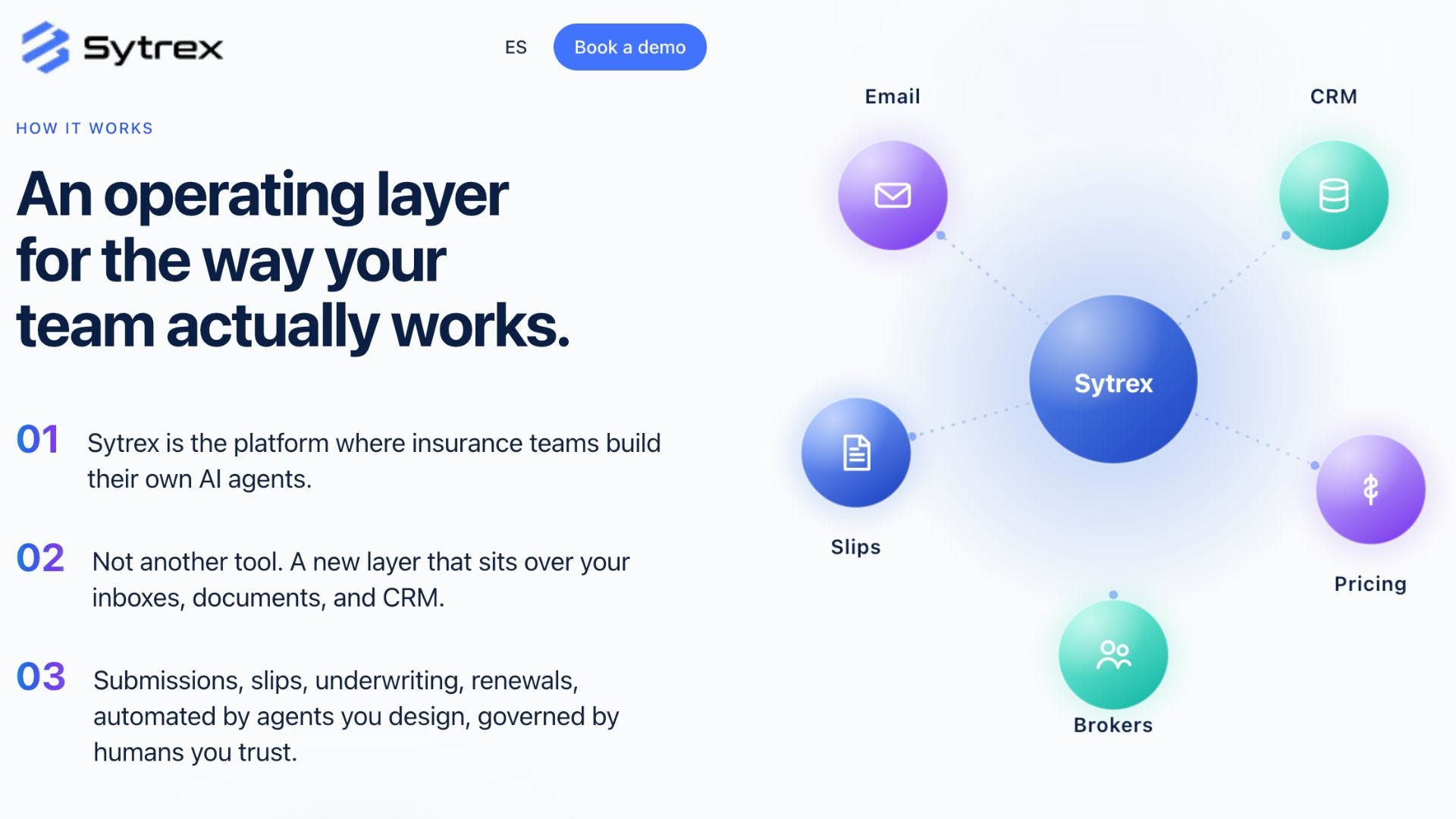
Sytrex builds AI-native infrastructure for the insurance industry. Carlos describes it as the “glue that’s in the middle of everything,” sitting between a sector where the pieces have never connected well. The platform integrates with the major systems of record that insurers already use, including Guidewire, Duck Creek, Salesforce, PPL, Whitespace, and VIPR, and layers agentic workflows on top of those connections.
The practical result is that insurance companies can automate end-to-end operations using agents that carry embedded industry knowledge. One example Carlos gives is an agent that already understands what underwriting property in Texas involves, the technical mechanics and the business logic specific to that geography and line of business. Companies can also configure agents to reflect their own internal processes, so the system works the way their organization works.
Building the Team Around a Simple Test
When it comes to hiring, Carlos looks for candidates who are genuinely hard to get. If recruiting someone feels too easy, he takes that as a signal he may not be aiming high enough. The people worth pursuing, he says, usually have a lot of opportunities and they know it.
His interview process includes a specific tell he listens for. The signal is when a conversation with a strong candidate starts to feel like a class, when the person is teaching him things he did not know and he finds himself wanting the conversation to keep going. He also keeps a handwritten notebook where he records the names of standout people mentioned across all his interviews. Ask enough candidates who the best person they have ever worked with is, and the same names start appearing. That list becomes the hire list.
In the current environment, Carlos prioritizes soft skills and attitude over specific technical capabilities. The tools Sytrex uses today may not be relevant in six to eight months. Someone with the right disposition will learn the new ones. As Carlos puts it, “it doesn’t really make sense to me to bring in people to the team based on a unique hard skill,” because models will eventually handle those capabilities anyway.
On the AI-native side of the team, Sytrex runs agents across sales development, content creation, design, and coding functions. But Carlos is careful about what gets green-lit. Before the team creates a new workstream, they ask one question: Can at least 80% of the execution be automated? If the answer is no, the opportunity cost usually makes it a poor trade.
Culture as Fuel, Not Decor
Carlos is candid about how culture can look to early-stage founders: a heavy lift with a low immediate return on investment, easy to defer until the business is more stable. The lesson he has taken from building multiple companies is that the return is very real, it just shows up in less obvious ways. Getting culture right, he says, is “a huge accelerator,” and getting it wrong decelerates a company by just as much.
At Sytrex, four cultural pillars govern how the team executes. First, extreme accountability means that once a number or a timeline has been committed to, that commitment is fixed. There is no renegotiating after the fact. Second, bias for action means people are expected to exercise judgment and move, not wait for permission. Third, an emphasis on thoughtful disagreement means Carlos is actively building a team that argues with evidence and pushes back when they think he is wrong.
“You don’t want a committee of people clapping at you because no one person can have all the good ideas.”
The fourth pillar is intellectual curiosity. When someone on the team discovers a new tool or technology and brings it back to the group, the whole team learns from it. Carlos describes the effect simply: if you have 10 different people reading and learning and having 10 different conversations, and they bring that back, everyone benefits.
In the past year, Carlos has brought the full Sytrex team to San Francisco three times, each for a full month of in-person work. The team lives together, runs internal hackathons, and opens the space to interactions with other companies. When asked about the cost of in-person meetups, his thinking is clear: if you’re building toward a billion-dollar outcome, that expense is marginal. The information and conversations that come from that kind of team proximity can change the outcome in ways that are infinitely powerful, if harder to quantify.
Fundraising as a Worldview Test
Carlos describes his early approach to fundraising as trying to be “that golden coin that everybody wants.” What shifted was his willingness to walk into a meeting with a genuine thesis: how he thinks the world is going to evolve, what bet he is making on that view, and whether the investor on the other side of the table sees it the same way. If they do not, Carlos says, that is normal. It is an obvious reason to move on. As he puts it, if the fundamentals you believe are different, the conversation should end there.
The Sytrex seed round generated seven term sheets because Carlos applied that filter consistently. He also ran simple qualification tests early in conversations with potential investors. Basic questions about whether they are using AI tools themselves, or whether they have built their own agent, reveal quickly whether someone can engage substantively with the decisions Sytrex will actually face in a boardroom. He also paid attention to whether investors were willing to make introductions on request. From that, he says, "you get a sense of the potential value that they could bring to you later."
For future rounds, his framework shifts based on stage. Pre-seed and seed rounds are bets on people, so the strongest conversations happen with investors who already know you. Series A and beyond should be raised on inflection points, with the clearest possible signal that a distribution channel is repeatable and scalable. When you have that data and can show it, Carlos says, “that’s the easiest sell in the world.”
Playing the Long Game from the Right City
Carlos made a deliberate decision to base Sytrex in San Francisco, and he is candid about what it required. Family-wise, San Francisco is very far from Colombia, and the cost of living demands real trade-offs. He made the move because the pace of what is happening in the city, he says, is unlike anything he has seen elsewhere.
He travels frequently for work, visiting London, New York, South America, and Dubai. Nowhere, according to Carlos, matches the speed of San Francisco right now. He has had conversations on a Monday that changed how he was thinking about a problem, only to change again by Thursday as the conversation evolved around him. That kind of environment, he says, is “such an unfair advantage” if you are inside it. The density of people building in AI, the quality of the dialogue available on any given day: these are things he has not found replicated anywhere else.
The work ahead for Sytrex is to continue building the connective infrastructure that a fragmented, document-heavy industry has long needed, now with a team past $1 million in ARR, a clear sales process, and the kind of cultural foundation Carlos spent two previous companies learning how to build correctly. He is exactly where he wants to be, and by his own measure, the energy has not let up.
More from Uncovered Media


